

4 MIN READ

October 24, 2026
CMBS (Commercial Mortgage-Backed Securities) require borrowers to make public quarterly and annual asset-specific performance metrics. This information can be very specific, like gross revenue, expenses, occupancy, debt coverage ratios, etc. It allows the public to look behind the iron curtain to understand just how a specific asset is performing. Many companies compile this information, like Trepp, and repackage and sell it. You can also get it for free if you know where to look.
There is value in understanding how specific assets are performing, but the macro picture that the CMBS data paints is real-time feedback into asset class performance.
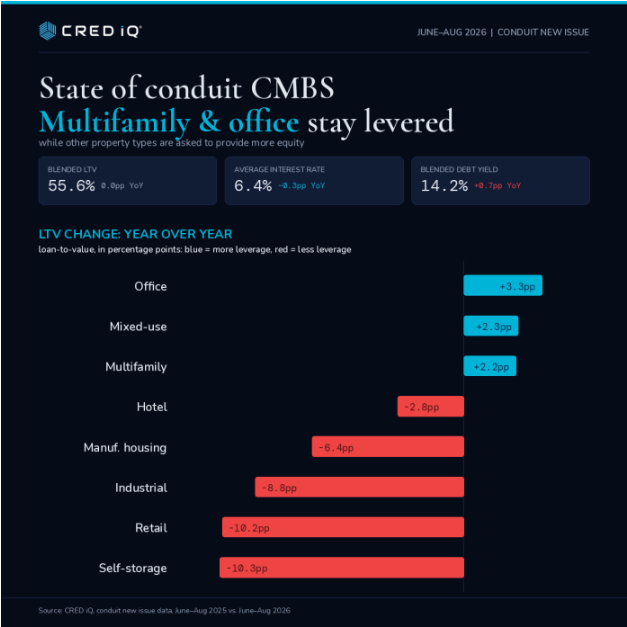
The first chart below looks at LTV (loan-to-value) on data from June-August 2025 vs June-August 2026. It’s just a small snapshot of data AND it’s before the 5-Year Treasury yields ran up 50 bps. I suspect that next time the data is analyzed for the end of this year, no asset class will have a higher LTV than the same time period in 2025.
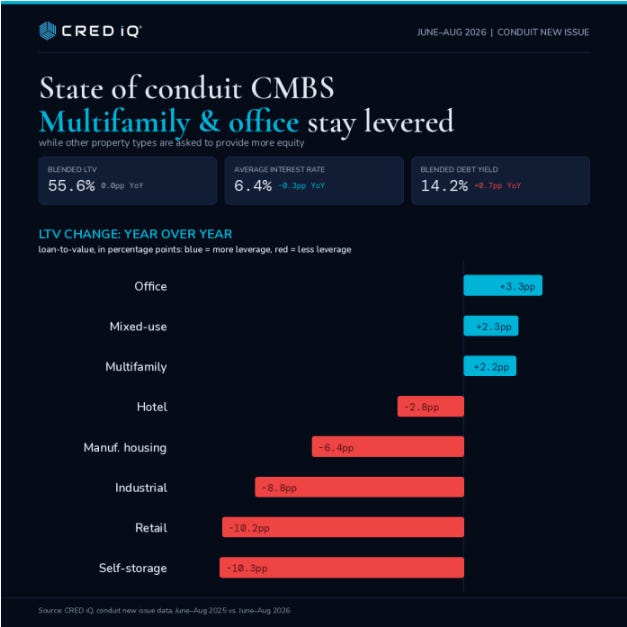
You can read this chart and come away with a couple of conclusions
- Office, Mixed-use, and Multifamily asset performance has turned the corner, and CMBS is getting more aggressive on LTV. Or maybe these borrowers just need more loan proceeds to keep kicking the can down the road. Multifamily loans are by far the highest leverage at 62% vs self storage the lowest at 46%.
- The other way to look at the data is to conclude that assets like Industrial, Retail, and Self Storage are performing better and are naturally deleveraging because of improved NOI, leading borrowers to be able to pull back on the leverage. Perhaps CMBS lenders are more cautious with these asset classes as well.
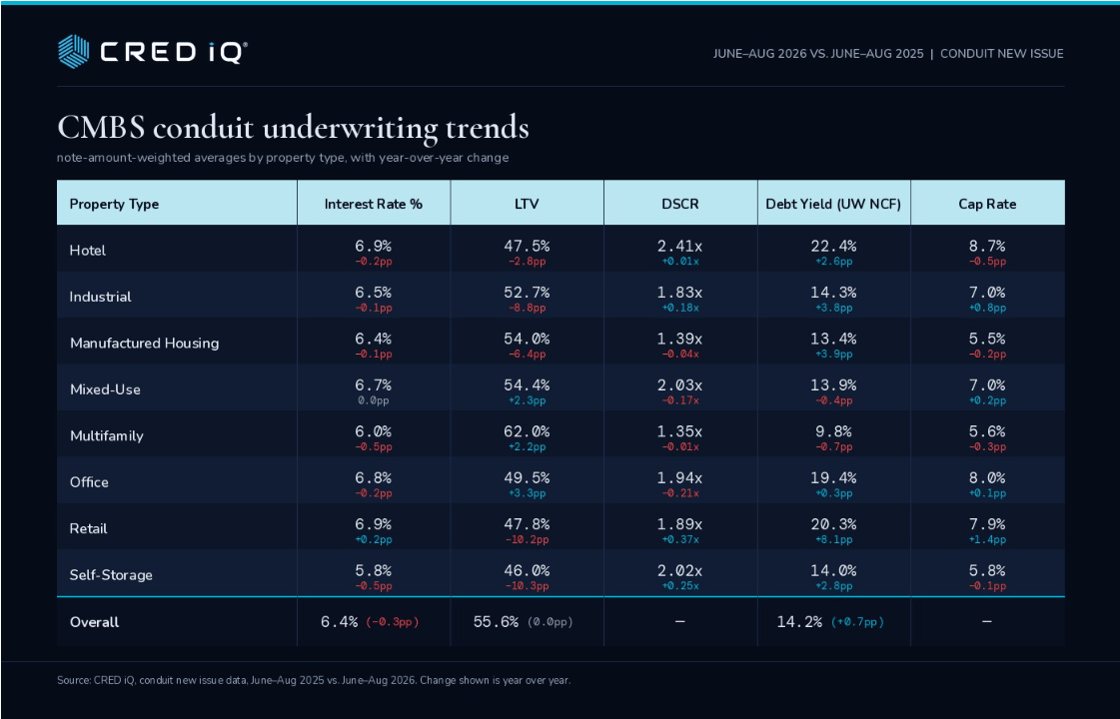
Diving into the data on the second chart, it appears that self storage is weathering the storm very well. It has the lowest average interest rate at 5.8%, the second-highest DSCR (Debt Service Coverage Ratio) at 2.02x and the third-lowest cap rate at 5.8%.
The CMBS data paints a fairly healthy picture of self storage.