3 MIN READ
Controllable Risks
 Drew Dolan
June 14, 2025
Drew Dolan
June 14, 2025


3 MIN READ
August 08, 2026

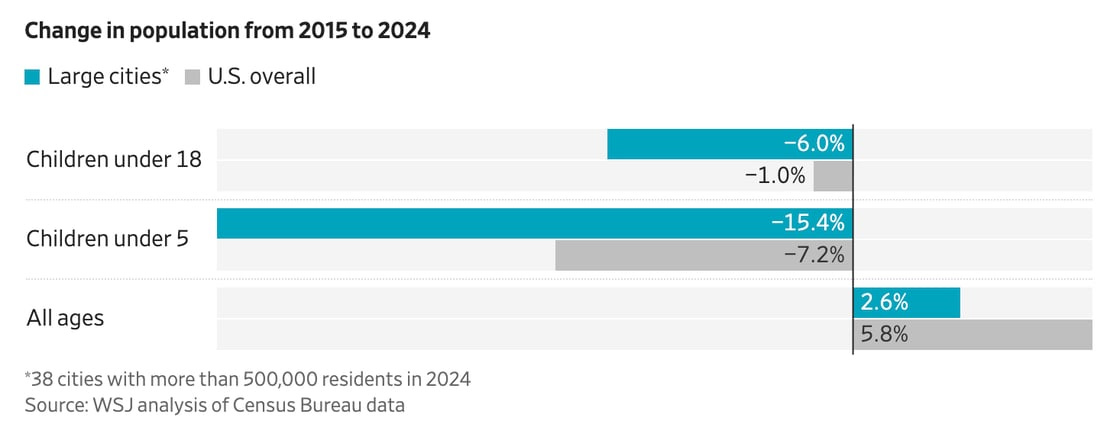
These two articles from the Wall Street Journal, (America’s Big Cities Are Rapidly Losing Kids, and A San Francisco Apartment Tower Ignites a Generational Fight Over Housing) complement each other perfectly. The first highlights how cities are losing families with young children. The number of children in major U.S. cities has dropped by 15% over the past decade because they cannot afford to live there. The second article focuses on the Marina neighborhood in San Francisco, which is fiercely opposing an 800-unit multifamily residential development.
Recently, I was the presenter for a proposed storage development at a neighborhood meeting in an unnamed, expensive, tertiary city. There was a debate about whether self-storage was a good fit for the community. About half of the attendees ignored the self storage and voiced strong support for affordable housing; they made sure the audience knew affordability was a problem and wanted everyone else to know that they were on board to fix it. Once the pro-affordable-housing theme gained traction and became the meeting topic, the audience flipped, making it clear that the site we were discussing just wasn’t suitable for housing. Developers often face the same set of objections to housing: increased traffic, higher crime rates, greater pressure on utilities, and more noise. Without proof to substantiate these claims, they get repeated often enough to shift the momentum in their direction. By the end of the meeting, after the housing rollercoaster ended, they seemed to accept that self-storage, with its low traffic, low crime, and low noise, was a reasonable option. While self-storage may not be sexy, it often succeeds where other projects fail.
Cities losing children are effectively sealing their own fate. Families drive local economies, spending money like crazy (I know this firsthand); older children take on jobs that many others won’t; and families demand better schools, fostering a more productive population. Yet school closures, once considered unthinkable, are now a reality—Los Angeles has already closed 14 schools in the past decade. Who will buy homes when baby boomers downsize or pass away? Traditionally, it was families, but if they’ve relocated to places like Fort Worth, won’t property values decline? Less demand, more supply, and lower prices seem inevitable.
While this might not pose an immediate issue for boomers, the problem is real, and eventually, the consequences will catch up.
LOAD MORE
4 MIN READ
 Martha Leeder
February 23, 2024
Martha Leeder
February 23, 2024