4 MIN READ
Death of the Cubicle
 Drew Dolan
May 30, 2026
Drew Dolan
May 30, 2026


5 MIN READ
February 07, 2026
I often tell the team, “real estate has a contrarian aspect.” When everyone is buying, it’s time to sell, and when everyone is selling, it’s time to buy. Perhaps it's because we have to look years ahead and predict what the market will be like by the time our investment is ready to sell.
This foresight is especially critical in self storage real estate development, where investment timelines are significantly longer. On average, it takes 18 months from site identification to construction start, and another 12 months to complete construction. After that, it takes 24-30 months to fully lease the property, meaning we’re planning 4-5 years ahead.
For self storage, the success of an investment largely hinges on new competition. Our product is a commodity—the 10x10 unit we rent in Nantucket is identical to the 10x10 unit in Albuquerque. While these markets couldn’t be more different, the product itself remains the same. Other key factors influencing success include rental rate growth, interest rates, property taxes, insurance, and accurate early estimates of construction costs. We can rely on historical, location-specific data to estimate many of these variables, but forecasting the volume of new self storage development over a 4-5-year period remains the most challenging and crucial factor to predict.
Self storage users don't want to drive more than 10-15 minutes to access their storage space. On average, that equates to a 3-mile radius from the site. To understand potential new competition, you have to understand every parcel's possibility to be developed into self storage in the future. Just five years ago, evaluating the development potential of every parcel within this radius was extremely time-consuming. It could take days to review zoning regulations, determine if the land was vacant and buildable, identify ownership, and assess whether there were plans to develop self storage on the site. If there are sites that are properly zoned, vacant, and have strong potential to become future self storage facilities, we’d need to evaluate whether they are better positioned than ours. Is there demand in the market for more than one new facility? Could we stabilize before their opening and maintain a competitive edge with our head start?
Today, this analysis can be done in minutes. While these tools don’t necessarily accelerate our decision to move forward on a project, they do streamline the process of saying "no-go" to a site. The underlying idea is that as we see more development opportunities, the environment becomes more competitive, and the deals we pursue are ultimately higher quality.
What does this have to do with a contrarian strategy, you ask? We are in an environment where raising real estate capital, especially for development projects, is incredibly challenging. Investors are grappling with deals from 2021 and 2022 that could be underwater, and they've seen minimal disposition proceeds over the past three years. Cities remain largely dysfunctional, interest rates are elevated, banks are increasingly selective, and to top it off, storage rental rates have fluctuated between -1% and +1% over the last two years.
This is precisely why, according to Radius+, self-storage deliveries are projected to decline by an estimated 70% between 2023 and 2026.
Self Storage Deliveries
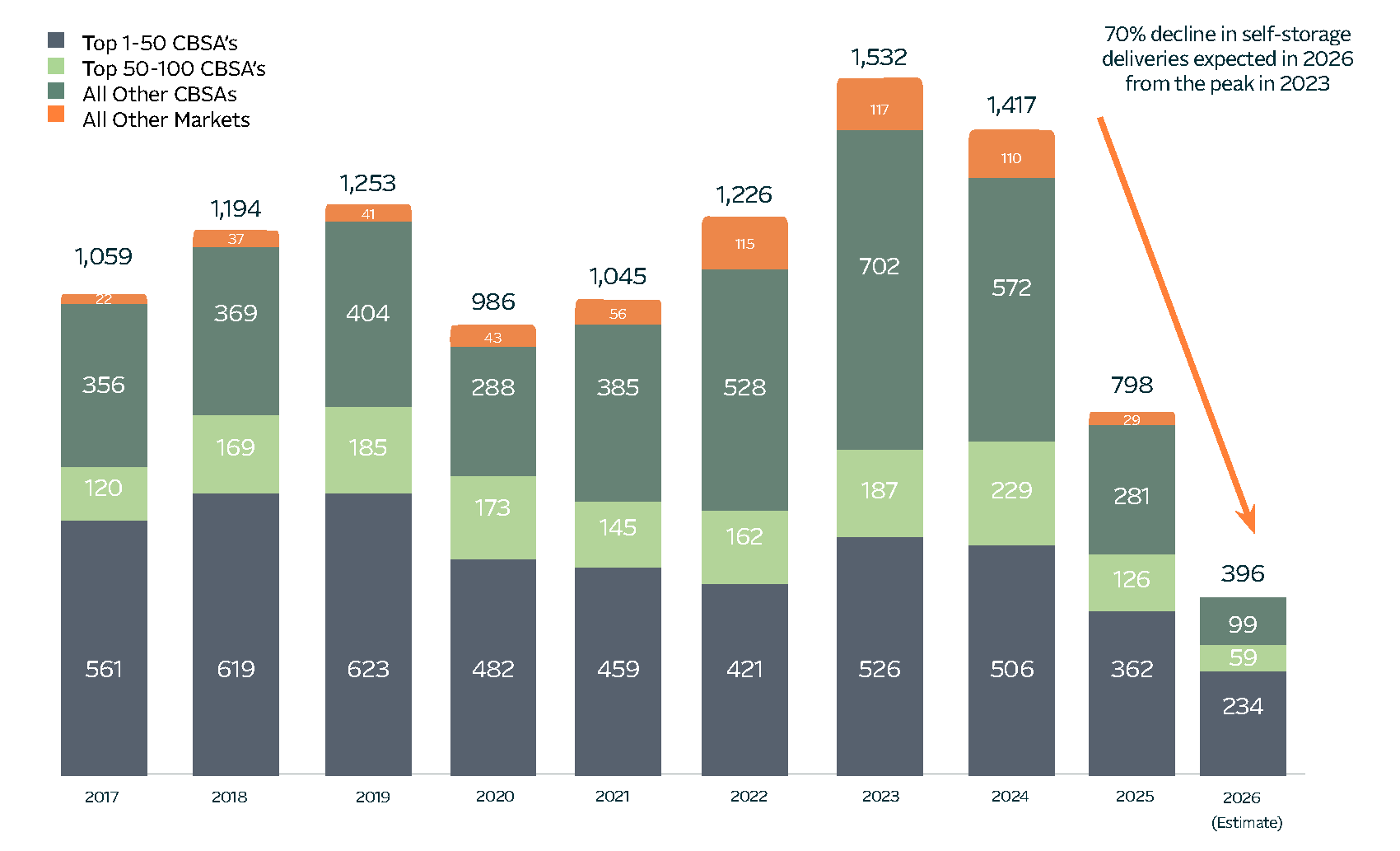 Source: Radius+, December 2025
Oversupply can undermine a strong self storage market. When too many developers build, supply exceeds demand, rental rates decline, investment timelines lengthen, and overall occupancy drops. While a macro view of the whole self storage market, as Radius+ produced, is helpful, we still only care about the 3-mile submarket. However, it does indicate that, overall, supply will lag behind demand, especially as millennials and Gen Z use self storage at a higher frequency than older generations (see previous blog, The Generational Shift in Storage). We’ve seen a similar scenario before, between 2013 and 2016, a period of low supply, REIT rents grew annually by 6-8%. The storage sector is poised to perform well over the next five years, but we must look beyond this year and the next to recognize the opportunities ahead.
LOAD MORE
2 MIN READ
 JT Mitchell
July 13, 2024
JT Mitchell
July 13, 2024
2 MIN READ
 DXD Capital
June 16, 2023
DXD Capital
June 16, 2023